2024–2025 Annual Report
Alcohol and Gaming Commission of Ontario
90 Sheppard Ave E., Suite 200
Toronto, ON, M2N 0A4
(416) 326-8700
www.agco.ca
customer.service@agco.ca
ISSN: 1911-9038 (Online)
© King's Printer for Ontario, 2025
Chair's Message
The Alcohol and Gaming Commission of Ontario (AGCO) entered the year with a clear vision to serve the people of Ontario through a common sense approach to outcomes-based, smart regulation.
This year was defined by strategic clarity and strong execution — the kind that quietly reinforces public trust, strengthens sector stability, and affirms the value of a regulator acting with clarity and purpose. Across every sector we regulate, the AGCO remained focused on ensuring that the standards we uphold reflect not only the laws of the province, but the interests of the people we serve and the businesses we regulate.
The AGCO’s success over this past fiscal year lies not only in what was delivered, but how it was delivered — with expertise, efficiency and in support of government priorities. That alignment was demonstrated in the agency’s work across all regulated sectors.
One of the most significant milestones was the expansion of alcohol retail sales through convenience and grocery stores across the province. The AGCO’s role in enabling this transformation was grounded in customer experience, responsible licensing, and a strong compliance model. In just a few months, more than 3,500 licence applications were assessed and issued, and thousands of new retail entrants supported — a clear demonstration of effective regulation in action.
In the cannabis retail sector, the AGCO continued its focus on maintaining high standards for public safety, while ensuring the regulatory environment supports fair market access and sector sustainability. The agency worked closely with provincial and enforcement partners—including the Ministry of the Attorney General, the Ontario Provincial Police, and the Ontario Cannabis Store—to combat the illicit cannabis market. To that end, we also directly engaged with a wide cross section of sector stakeholders and service providers to explore the challenges and partnership opportunities for reducing the illegal market’s footprint.
The AGCO continued its strong oversight of Ontario’s igaming market. By the end of the year, 50 operators and 83 active websites were registered, with the province achieving a channelization rate of approximately 85%, indicating the legal market's ability to capture a significant share of players. Additionally, this year, the Government of Ontario announced its intention to establish iGaming Ontario as an independent agency reporting to the Ministry of Tourism, Culture and Gaming, rather than operating as a subsidiary of the AGCO. We are proud to have played a pivotal role in establishing iGaming Ontario in its early days and will continue to work together to ensure a stronger, safer, and responsible igaming market for the province.
Sustainability is at the core of modern regulation — not only in fiscal terms, but in design, delivery, and trustworthiness. In 2024–2025, the AGCO advanced key reforms to modernize its licensing, streamline its inspection models, and improve its digital service. The agency also delivered on important accountability commitments, including through continued action on the Auditor General’s Value for Money Audit recommendations.
Throughout this progress, the Board of Directors remained focused on risk management, strategic renewal, good governance, and organizational readiness. That work culminated in the approval of the AGCO’s new 2025–2028 Strategic Plan. Built around four priorities — reducing harm, fostering industry sustainability, strengthening internal capacity, and developing talent — the Plan reflects our shared vision and commitment to the agency’s role in sustaining the public interest.
As we look ahead, it is important to acknowledge those who have made these successes possible. I would like to thank our Board of Directors and particularly acknowledge outgoing Board members Cara Vaccarino and Heidi Reinhart for their valued contributions and service to the AGCO Board, the agency and the people of Ontario. Cara completed her term as a Director in 2024-2025 and Heidi stepped away from her duties as a Director in 2025-2026 when iGaming Ontario was established as an independent agency, as she is the Chair of the iGaming Ontario Board. I also extend my appreciation to CEO and Registrar Karin Schnarr, the executive team, and all AGCO staff for their dedication, professionalism, and commitment to public service.
Regulation, when done well, protects and enables. I’m pleased to present this annual report, detailing how the AGCO’s efforts over the past year have successfully met both of these objectives.
Dave Forestell, Chair
CEO's Message
The 2024-2025 fiscal year marked my first full year as Registrar and CEO of the AGCO, and it has been a privilege to lead an agency that plays such an important role in the lives of Ontarians. From modernizing our regulatory frameworks to supporting transformational change across the sectors we regulate—alcohol, gaming, cannabis retail, and horse racing—our focus remained on delivering smart, responsive and effective regulation that protects the public while enabling industry vitality.
Over the past year, I met with our stakeholders in their storefronts, in one-on-one meetings and at industry forums. This open, continuous and direct communication reinforced that our stakeholders are passionate about their businesses and see the AGCO as key to their sustainability. They recognize the value of regulation and urge us to uphold public trust while enabling their success – which we are committed to doing. I’ve also regularly engaged with AGCO staff across the province and continue to be inspired by their dedication, professionalism and commitment to the public and sector stakeholders.
One of the most significant areas of focus this year was the expansion of alcohol sales to convenience and grocery stores—a Government of Ontario initiative aimed at offering Ontarians greater choice and convenience. We worked closely with the LCBO and other stakeholders to support the end-to-end experience of new retailers, from licence application to inventory ordering and delivery. By the close of this fiscal year, the AGCO had issued nearly 5,700 licences and conducted over 8,800 inspections, ensuring safeguards remained firmly in place. We accomplished this while facilitating market access for eligible businesses and helping to deliver on a major government priority.
In the cannabis sector, the AGCO maintained its commitment to protecting the public while supporting the sustainability of private cannabis retail. A notable achievement was the successful rollout of a new point-of-sale data platform, in partnership with the Ontario Cannabis Store. Using technology, changes were introduced to make it easier for retail operators to track and report on inventory and sales. This new process reduces the burden of manual reporting and creates a system-wide guardrail that protects against the risk of diversion to the illicit market.
This year marked the third year of Ontario’s open and regulated internet gaming (igaming) market—a model that continues to gain national and global attention. The AGCO remained focused on upholding high regulatory standards that foster a competitive and responsible market, and one that establishes strong protections for players. Our work is making a real difference in creating confidence in Ontario’s legal gaming market.
As regulator, we enforce strong standards that guard against unlawful activity and support the broader anti-financial crime ecosystem. Our standards require gaming operators to protect against attempts at money laundering, report suspicious activity, and intervene with players who may be susceptible to using illicit funds in the market. Additionally, as we continue to prioritize safer gambling safeguards, the AGCO proactively conducted 15 responsible gambling compliance reviews on average every month to ensure igaming operators were fulfilling their obligations. Due to our standards, igaming operators intervened with patrons displaying risky behaviour over 89,000 times each month, on average.
To protect the integrity of horse racing, the health and welfare of racehorses and the safety of all participants, the AGCO introduced new rules and protocols this year. These included enhanced safeguards before a change of horse ownership and a series of evidence-based measures at Woodbine Racetrack following a concerning rise in catastrophic injuries at the end of the season. These changes reflect our commitment to acting quickly and collaboratively to uphold the safety of both animals and participants.
In March 2025, we launched a new three-year Strategic Plan—a roadmap shaped through consultation with stakeholders, guidance from our Board, and a clear focus on public interest. The plan positions us to be an even more data-driven, outcomes focused regulator that is responsive to Ontario’s changing social and economic landscape.
With the goal of responsible financial stewardship, we made changes to strengthen our organization’s financial management and oversight. We established a dedicated Finance and Risk Management Division to enhance our strategic capacity and move toward financial self- sufficiency. We also reorganized our team to establish a new People and Culture Division, underscoring our commitment to employee achievement, well-being and talent development.
The AGCO remains committed to fostering an inclusive workplace and delivering services in an accessible, culturally aware and responsive way. The AGCO’s new Strategic Plan confirms that diversity, inclusion and accessibility remain central to our role as an employer and service provider. We were honoured to be recognized as one of Greater Toronto’s Top Employers for the second consecutive year. This recognition affirms our values and the positive culture we continue to cultivate at the AGCO.
Looking ahead, we will remain agile and focused on protecting the public while supporting vibrant, sustainable sectors. We are committed to being a world-class regulator—one that reduces the risk of harm while enabling innovation and responsible growth through smart regulation. Whatever challenges lie ahead, we will continue working alongside our customers, stakeholders and government partners to shape a regulatory environment that is trusted, future- ready, and aligned with the needs of Ontarians.
Dr. Karin Schnarr, Registrar and CEO
About the AGCO
Introduction
The Alcohol and Gaming Commission of Ontario (AGCO) is an Ontario provincial regulatory agency reporting to the Ministry of the Attorney General (MAG). It is a corporation under the Alcohol and Gaming Commission of Ontario Act, 2019 .
The AGCO is responsible for regulating the alcohol, gaming, horse racing, and cannabis retail sectors in accordance with the principles of honesty and integrity, and in the public interest. In so doing, the AGCO administers the Liquor Licence and Control Act, 2019, the Gaming Control Act, 1992, the Horse Racing Licence Act, 2015 and the Cannabis Licence Act, 2018. The AGCO also administers the charity lottery licensing Order-in-Council 208/2024.
AGCO Subsidiary
iGaming Ontario (iGO) was established as a subsidiary corporation of the AGCO in 2021. iGO is responsible for conducting and managing igaming through private operators in Ontario. The AGCO’s role as a regulator is kept separate from iGO’s commercial role. The AGCO continues to be responsible for regulatory oversight of all gaming activities in Ontario, including private igaming operators, suppliers and iGO. Companies who successfully enter the Ontario market are required to meet rigorous standards of game and operator integrity, fairness, player protections and social responsibility.
The AGCO’s Annual Report must contain the Annual Report of its subsidiary. As such, the iGO Annual Report is appended. On May 12, 2025, the Government of Ontario proclaimed the iGaming Ontario Act, formally establishing iGaming Ontario as an independent agency. As of that date, iGO is no longer a subsidiary of the AGCO and reports to the Ministry of Tourism, Culture and Gaming, led by the Honourable Stan Cho.
Board of Directors
The AGCO Board of Directors (the Board) is responsible for the overall governance of the AGCO. In exercising its governance functions, the Board sets goals and strategic direction for the agency to fulfill its mandate; this includes working with the Chief Executive Officer and senior management on regulatory and governance activities.
As part of its governance structure, the Board meets regularly and has two standing committees. These committees are the Finance, Audit and Risk Management Committee and the Strategic Oversight and Governance Committee. The committees are accountable to the Board and provide regular updates at board meetings, highlighting key decision points, areas of substantive discussion and recommendations to the Board.
- The Finance, Audit and Risk Management Committee is responsible for providing oversight on matters related to financial performance. This committee also provides oversight on cybersecurity, internal audit activities, risk management and emergency management, including internal control systems, and annual risk management and audit plans.
- The Strategic Oversight and Governance Committee is responsible for ensuring the agency has an effective governance framework and is carrying out its responsibilities and fulfilling its legislative mandate. This committee is responsible for monitoring and assessing the agency’s performance against key strategies and objectives and providing strategic oversight with respect to the AGCO’s human resources strategy.
Appointments to the AGCO Board are administered through the Public Appointments Secretariat. The Board is currently composed of a Chair and five Members, all of whom are part-time appointees. The AGCO maintains a Skills Matrix which is shared with the Attorney General on an ongoing basis. The intent of the Skills Matrix is to identify a broad range of required experience, skills and qualifications for the Board so that it can continue to provide effective oversight of the agency.
Table 1 reflects members of the Board who served during the fiscal year ending March 31, 2025, including their original appointment dates.
Total per diems of all appointees for fiscal year 2024–2025: $92,151.86
Member |
Date First Appointed |
Most Recent Appointment Term |
Total Remuneration FY 2024–25 | Regular Board & Committee Meeting Attendance |
|---|---|---|---|---|
| Dave Forestell Chair | December 12, 2018 | July 20, 2024 – July 19, 2027 | $30,480.06 | 100% |
| Paul Stoyan Vice-Chair | July 29, 2021 | August 31, 2023 – August 30, 2025 | $14,278.81 | 100% |
| Cara Vaccarino Member Chair of Strategic, Governance and Oversight Committee | February 14, 2020 | February 14, 2022 – February 13, 2025 | $7,785.29 | 88% |
| Douglas McLarty Member Chair of Finance, Audit and Risk Management Committee | February 20, 2020 | February 20, 2025 – February 19, 2026 | $12,264.40 | 100% |
| Neil Desai Member Chair of Strategic, Governance and Oversight Committee (effective February 2025) | September 17, 2020 | September 17, 2022 – September 16, 2025 | $16,496.11 | 100% |
| Heidi Reinhart Member1 | October 29, 2020 | September 16, 2023 – September 15, 2026 | $2,357.71 | 80% |
| Alan Gertner Member | July 11, 2024 | July 11, 2024 – July 10, 2026 | $8,489.48 | 100% |
The AGCO organizational structure is appended.
1 Heidi Reinhart is the Chair of the iGaming Ontario Board and stepped away from her duties as an AGCO Director in 2025-2026 when iGaming Ontario was established as an independent agency. 
Fiscal Year 2024–2025
The fiscal year 2024–2025, spanning April 1, 2024 to March 31, 2025, was a period defined by evolution and strategic renewal for the AGCO. With the previous Strategic Plan concluding at the end of fiscal year 2023–2024, the agency focused its efforts on shaping a refreshed roadmap for the years ahead. This involved significant engagement across the agency, including leadership discussions, collaborative workshops and in-depth planning to identify priorities for the next three-year cycle. These efforts culminated in the development and launch of the AGCO’s new 2025–2028 Strategic Plan.
The 2025–2028 Strategic Plan reinforces the AGCO’s commitment to protecting the consumer, making room for our licensees to innovate, and a common sense regulatory approach. Grounded in an outcome-based approach, it is anchored by four strategic goals: Reduce the Risk of Harm, Foster Industry Sustainability and Innovation, Strengthen Our Organizational Foundation, and Attract, Retain and Develop our People. These priorities reflect the AGCO’s essential role as a nimble, right-sized regulator that balances consumer safety and public interest while fostering a dynamic, competitive business environment. Efforts undertaken in fiscal year 2024–2025 laid the groundwork for the new Strategic Plan, setting a focused and aligned course for the agency over the next three years.
Figure 1: AGCO Strategic Goals
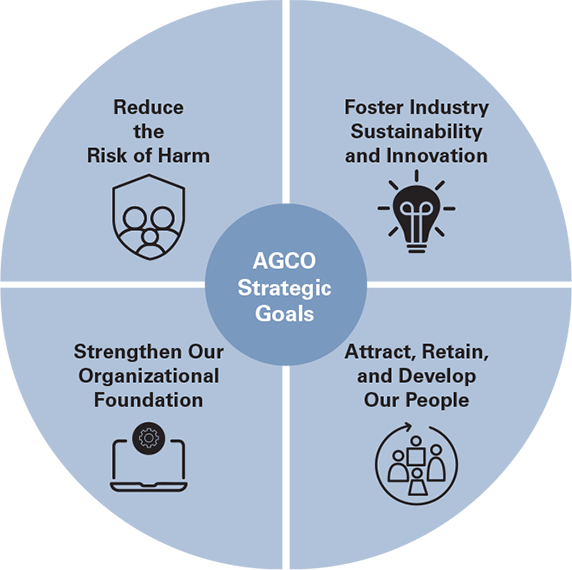

Further mature our strategies and approaches for combatting illegal markets and enhance proactive harm reduction programs and processes.

Advance the reduction of red-tape and unnecessary regulatory burden, expand our support of innovation in regulated sectors, and increase agility in responding to evolving market trends and needs.

Continue to utilize modern operating models and advance our capabilities, tools and systems in a way that builds digital technology into our core work, providing streamlined and increasingly helpful services to our stakeholders.

Build and strengthen the talent and skills of our team to offer leading services to stakeholders, while championing a culture of diversity, inclusion and accessibility.
Strategic Goals
Reduce the Risk of Harm
Reducing the risk of harm is central to the AGCO’s purpose and mandate. By prioritizing proactive harm reduction and a robust approach to combatting illegal markets, the AGCO is focused on assuring Ontarians that our markets are safe and responsible, while supporting legal operators and licensees by leveraging key partnerships to eliminate illicit actors.
The AGCO will bolster its vigilant approach to monitoring emerging risks across sectors through harm reduction frameworks and standards that reflect industry best practices and integration with our stakeholders’ activities. This includes deepening collaboration and partnership with social responsibility, public health and law enforcement stakeholders to enhance strategies to combat illegal markets and protect minors and communities.
Foster Industry Sustainability and Innovation
The AGCO is focused on fostering competitive, safe and fair markets that balance robust regulatory oversight with minimal regulatory burden and expanded consumer choice. The AGCO is committed to identifying and advocating for the removal of regulatory barriers, expanding support of innovation in regulated sectors and strengthening operational readiness to be responsive to evolving market trends and needs.
Regulatory frameworks can be key enablers to facilitating innovation and healthy participation in our markets. By identifying and responding to emerging needs and mitigating risks, we put customers at the centre of our programs and provide services that reduce unnecessary burdens on businesses by focusing on smart regulation.
Strengthen Our Organizational Foundation
As our existing sectors evolve, diversify and as new sectors emerge, the AGCO remains committed to adapting operational approaches and building upon our strength as an agile, common sense-driven regulator. This commitment extends to strengthening an organizational foundation that reflects the same focus on outcomes, efficiency and innovation that the AGCO uses in its regulatory approach.
Digital enablement of the AGCO’s strategic goals and continued integration of technology into core work and culture is also a key focus. An increasingly digitized operating model improves performance by creating efficiencies, streamlining interactions with stakeholders, and enabling the AGCO to leverage data to support and inform decision-making. This ensures new initiatives and service updates accurately reflect the needs of our stakeholders and provides sophisticated tools to monitor and assess compliance programs, market trends, and customer and employee satisfaction.
Attract, Retain and Develop Our People
Our people play a key role in ensuring the AGCO remains a leading regulator with modern, efficient and effective processes. To ensure the work environment embodies the agility with which we regulate, we will further build and invest in the talent and capabilities of our team to offer best-in-class services to our customers and stakeholders.
By being open to new ways of working, prioritizing employee well-being and ensuring our values translate into our culture, we will attract and retain top talent with in-demand skills and help build an optimal workplace culture to deliver on our mandate. In so doing, we are committed to establishing a team reflective of Ontario’s demographic diversity, prioritizing inclusiveness, and fostering a workplace that is increasingly free of discrimination and provides a safe space for all points of view.
Performance Measurement
The AGCO has developed a series of outcome-based performance measures to evaluate progress against and alignment with the four strategic goals. We will prioritize collecting and analyzing new data sets to establish baselines where needed to enable this critical element of our plan. These measures offer insight into overall direction, highlight successes, identify emerging risks, enable data driven decision-making, and strengthen our ability to be agile and drive continuous improvement in a dynamic environment.
| Performance Measure | Target | |
|---|---|---|
| Reduce the Risk of Harm | ||
| Average Compliance Rate Related to Youth Protection # of findings of non-compliance related to youth access (liquor, cannabis, lottery & land-based gaming) |
Establish Baseline2 | |
| Foster Industry Sustainability and Innovation | ||
| Service Standard Achievement Frequency that service and processing standards are met |
80% of the time | |
| Strengthen Our Organization Foundation | ||
| Digital Maturity Scored index reflecting overall digital capability maturity across strategic, service delivery and enabling capabilities |
Establish Baseline2 | |
| Attract, Retain, and Develop Our People | ||
| Employee Engagement Score Aggregate score indicating engagement of employees across the organization |
Establish Baseline2 | |
2 The fiscal year 2025–2026 will be the first year of monitoring and reporting on performance measures outlined in the 2025–2028 Strategic Plan. Reporting will begin for measures with established baselines, while others will be developed throughout the year. All baselines are expected to be set by fiscal year-end, with targets updated accordingly.
Key Achievements by Sector
Alcohol
Throughout the fiscal year 2024–2025, the AGCO successfully fulfilled the Government of Ontario’s mandate to expand the liquor retail marketplace to include grocery and convenience stores. This multi-phase expansion, completed on October 31, 2024, represented the most significant change to Ontario’s alcohol retail landscape in nearly a century. The AGCO played a critical role in facilitating a stable transition, ensuring the marketplace remains responsible, efficient, and accessible to consumers while upholding public safety and regulatory integrity.
Key achievements include:
- Modernized Licensing & Regulatory Efficiencies – The AGCO worked with the government to adopt a simple and straightforward approach to licensing new retail outlets, facilitating automatic issuance of thousands of new licenses. This streamlined licensing model was a critical component to the success of the new market and significantly lowered barriers to entry and expedited market access for thousands of businesses.
- Commitment to Compliance & Responsible Retailing – The AGCO introduced an updated compliance approach tailored to the expanded market, with a strong focus on preventing youth access to alcohol and deterring illicit market activity. Additionally, eight new AGCO Board-approved retail training programs were launched to support responsible alcohol sales and service, increasing choice for licensees and spawning a new competitive training market in Ontario.
- Ongoing Compliance & Public Safety Efforts – The AGCO continued to administer the Police Report and Last Drink Programs, reinforcing its collaborative compliance efforts with police, fire services, municipal by-law officers and public health units. The Mystery Shopper Program was expanded to cover all liquor licensees across the province, enhancing oversight and preventing youth access to alcohol.
- Industry Support & Engagement – To facilitate a smooth transition, the AGCO engaged directly with its stakeholder and industry associations to develop a range of resources, including novel guidance materials, plain language standards and training seminars. Ongoing collaboration with industry associations ensures alignment between regulatory oversight and business needs.
- Establishing the Service Journey for Liquor Retail Expansion – In collaboration with the LCBO, a step-by-step customer journey map was created, published on the AGCO website, and promoted through stakeholder engagements to guide applicants through the process and help prepare stores for responsible liquor sales. The AGCO also updated its complaints and inquiry handling process to monitor this new service experience and report on service effectiveness.
As the expansion transitions into steady-state operations, the AGCO remains committed to fostering a balanced, responsible, and consumer-friendly marketplace while continuing to support government modernization initiatives.
Gaming
During the fiscal year 2024–2025, the AGCO advanced a range of initiatives to support Ontario’s evolving gaming sector, including charitable gaming, land-based commercial gaming, igaming, and lottery. These activities align with key government priorities to support a healthy and sustainable gaming industry while maintaining a focus on responsible gambling and player protection.
Charitable Gaming
Ontario has a rich and robust charitable fundraising culture, and the AGCO plays a critical role in ensuring the opportunities available to these important organizations continue to evolve and modernize to reflect their changing needs. These updates reflect the AGCO’s ongoing commitment to oversee a modern charitable gaming sector that prizes innovation, access and burden reduction for its participants. These included:
- Updated the charitable lottery licensing policies to permit subscriptions with automatic billing for electronic raffles.
- Updated the Electronic Raffle Operational Terms and Conditions and the Electronic Raffle Minimum Technical Standards to permit a new single number, multi-chance technical solution for electronic raffle sales.
- Introduced a new combined charitable gaming ticket type, allowing eligible charities to combine a Break Open Ticket (BOT) with another BOT and/or raffle on a single ticket.
- Revised 50/50 raffle policies to include the ability of eligible charities to split the 50% prize pot between multiple winners.
- Amended the age requirement for eligible youth amateur sport organizations applying for a charitable lottery licence, requiring that all players must be 21 years of age and under at the start of the sporting season. Previously, a majority of players were required to be under the age of 18 years. This change provides greater fundraising flexibility for youth amateur sports organizations and aligns the AGCO’s policies with the varying ages of players in youth amateur sports teams in Ontario.
Land-Based Commercial Gaming
Land-based casinos are an important part of Ontario’s economic success, generating hundreds of millions in revenue for the Ontario government and employing thousands of people across the province. Over the course of the fiscal year 2024–2025, the AGCO undertook a range of activities to support the effective regulation of the land-based commercial gaming sector and to support the health of its players:
- The Regulatory Anti-Money Laundering (AML) Operational Dashboard moved out of the pre-production “alpha” stage, and into production on February 27, 2025. The final pillar of the Dashboard, “Honesty & Integrity”, has been built and reviewed, and is anticipated to go-live by June 2025 for use by the AML Oversight Team. The AML Dashboard will allow the AML Oversight Team to identify trends across the Operator group and identify areas to focus limited resources to promote compliance through targeted AML inspections/activities.
- The Responsible Gambling Casino Leaders Forum was established with the Ontario Lottery and Gaming Corporation to bring together leaders across the casino sector to share perspectives, learnings, new initiatives, trends, raise emerging issues and identify opportunities for collaboration and alignment in areas of research, program development and data sharing related to responsible gambling and player health in Ontario.
igaming
Since its launch in 2022, Ontario’s internet-based gaming market has continued to defy expectations in market capture, revenue generation and consumer choice. The AGCO plays a key role as steward of the made-in Ontario regulatory approach that has facilitated this success, and continued to maintain its focus on ensuring the model supports a competitive igaming market that is commercially successful, protects consumers and provides them with product choice.
- The AGCO introduced the new Responsible Gambling and Player Health Forum, to facilitate regular engagement on emerging issues and topics of potential regulatory interest or industry concern. Through this forum, the AGCO engages with various stakeholders to solicit input from a variety of experts who have an interest in a safe and successful igaming market in Ontario.
- Through the Responsible Gambling and Player Health Forum, the AGCO engaged with igaming operators to identify best practices for identifying and supporting players at risk of harm – a key accountability for igaming operators in Ontario. The results of this engagement were used to develop industry guidance for all operators, a key compliance tool to assist the Ontario igaming industry to lead the way in minimizing the risk of player harm.
- Work is underway to continue tackling the unregulated igaming market that persists in Ontario. Building off previous efforts, the AGCO is executing several initiatives to address and minimize the unregulated market, including meeting with intermediaries in the digital services space, conducting channelization research and sending targeted letters to registered Gaming-Related Suppliers. The letters list known unregulated sites in Ontario where their games are present and request confirmation that the games are blocked from play on those sites. Additionally, the AGCO contacted more than a dozen traditional and digital media platforms, calling on them to stop promoting unregulated online gambling and sports betting sites like Bodog to Ontario residents.
- The AGCO is simultaneously collaborating with other jurisdictions given the international regulatory community is increasingly prioritizing joint efforts to address illegal online gambling activity around the world.
Lottery
In September 2022, the Ontario Lottery and Gaming Corporation (OLG) announced plans to implement new self-serve terminals (SSTs) in lottery retail locations which began rolling out in February 2024. Throughout the fiscal year 2024–2025, the AGCO continued to work closely with the OLG in support of the continued implementation of SSTs, including amendments to the Registrar’s Standards for Gaming: Lottery Sector. These amendments enabled the placement of SSTs on casino gaming floors by exempting them from line of sight requirements, in recognition of the robust surveillance in place to minimize unnecessary burden on casino operators.
Horse Racing
The sport of horse racing has been part of Ontario’s history for hundreds of years and is an important part of province’s economic success, supporting thousands of jobs within the racing industry and across other sectors in rural communities, such as farming, breeding and agriculture. It also contributes millions of dollars in annual Ontario tax revenue. As part of the AGCO’s ongoing commitment in protecting Ontario’s racehorses, enhancing the integrity of racing and providing a regulatory framework appropriate for today’s racing industry, AGCO announced and implemented a number of reforms in fiscal year 2024–2025.
These included:
- Expanded the invalidation of claims rules to include Thoroughbred and Quarter Horse classes to provide additional protection for racehorses and the racing industry during claiming races. The revisions allow a claim to be invalidated in certain circumstances following a claiming race.
- In response to a request from Ontario Racing, the AGCO updated the Standardbred Rules of Racing to allow increased flexibility to the qualifying standard for the Ontario Sires Stakes Prospect Series, promoting more opportunities for young racehorses to be eligible to race. Following a successful pilot at Mohawk Raceway that allowed for an increase in the number of horses eligible for entry and created more competitive fields, the AGCO has made this a permanent change to the Standardbred Rules of Racing to benefit all Standardbred racing tracks in Ontario.
- To address an increase in catastrophic equine injuries at Woodbine Racetrack towards the end of the 2024 racing season, the AGCO directed Woodbine to implement a series of evidence-based measures to provide confidence that operations could resume safely in the final weeks of the season. This included safety measures intended to protect the health and wellbeing of racehorses which were further refined in January 2025.
- As part of the AGCO’s commitment to protecting racehorses, the AGCO initiated equine welfare research to assess its rules and policies to improve the safety and welfare of Ontario racehorses and support the sustainability of the industry.
Cannabis
Since opening in 2019, the regulated cannabis market has seen significant growth and development; however, at the same time the AGCO also understands that there are new competitive challenges for existing and prospective operators. Over the past year, the AGCO has focused on supporting cannabis retailers’ ability to be competitive by enhancing flexibility, reducing burden and streamlining processes. To further protect the integrity and success of the regulated market, the AGCO continues to support the government in combatting the illicit cannabis market.
- The AGCO has built a strong foundation of partnerships to support the government’s objective of combatting the illicit cannabis market through collaboration with provincial partners, including the Ontario Cannabis Store (OCS), Ontario Provincial Police, other industry partners and government. To enhance public awareness and help consumers choose legal products, the AGCO partnered with the OCS on its fall 2024 Buy Legal public awareness campaign. Also in fall 2024, the AGCO Chair began building collaborative relationships with key actors in sectors that share a common interest in addressing the illicit market.
- In July 2024, the AGCO supported the government in bringing into effect regulatory changes permitting cannabis retail stores to access spaces shared with other businesses in certain circumstances, allowing for more flexibility in store layouts.
- All cannabis retail store employees are required to successfully complete an AGCO Board-approved cannabis retail employee training program before their first day of work. In August 2024, the AGCO Board of Directors approved a second cannabis retail training program named CTC 1: Retail Certification Program.
- The AGCO continued its collaboration with the OCS to finalize the implementation of a new Point-of-Sale Data Reporting Platform, enabling the automatic submission of operators’ retail data directly to the OCS, reducing burden and standardizing reporting.
- An internal Data Driven Compliance application has been developed to make better use of data to support AGCO inspectors’ ability to focus their activities on entities that present the highest risk of non-compliance. In fiscal year 2024–2025, this application was launched in the cannabis sector, and plans are underway to continue expanding its use across other sectors to enhance the AGCO’s inspection capabilities.
- Enhanced Cannabis Application Pre-Screening Interviews continue to be essential in supporting the honesty and integrity of licensees, registrants, and authorization holders and allow for immediate flagging of any criminal associations. In fiscal year 2024–2025, Eligibility and Major Investigations conducted 340 cannabis-related investigations and noted a significant decrease in the identification of problematic applications. This is attributed to the registered cannabis market maturing and key messaging being conveyed within the industry of the OPP’s thorough background investigations on applicants and entities.
- Following amendments to the Cannabis Licence Act, 2018 in 2023, the AGCO supported the Ministry of the Attorney General in implementing and operationalizing regulatory changes to enable the transfer of Retail Store Authorizations from one licensed operator to another, and to allow the sale of cannabis from one operator to another in prescribed circumstances. These changes reduce burden and streamline the licensing process.
Achievements in Accordance with Mandate
In fiscal year 2024–2025, the AGCO remained committed to delivering on its mandate by supporting the Government of Ontario’s priorities through modern, efficient and data-informed regulatory services. Aligned with direction from the Attorney General’s mandate letter to the AGCO, the AGCO advanced initiatives that promote competitiveness, sustainability and effective expenditure management, while strengthening transparency, accountability and workforce practices. We made significant progress in modernizing the liquor retail marketplace, reducing regulatory burden and enhancing the use of data and digital service delivery. The AGCO also continued working with partners to support a safe and robust cannabis retail market, advance cost recovery considerations for licensing fees and implement outstanding recommendations from the Auditor General’s Value for Money audit.
The following section highlights the achievements made over the fiscal year in support of these priorities and our ongoing commitment to effective and responsible regulation.
Competitiveness, Sustainability, and Expenditure Management
In December 2020, the Auditor General of Ontario released a Value for Money Audit Report of the AGCO. The report contained 26 recommendations and proposed 62 action items, along with management responses from the AGCO and the Ministry of the Attorney General.
At the end of fiscal year 2024–2025, 10 recommendations comprising of 15 action items remain outstanding. Over the past fiscal year, the AGCO has continued to deliver steady progress and submitted its final five-year follow-up status update on these outstanding action items to the Auditor General on March 31, 2025.
Based on the AGCO’s self-reported status, nine of the outstanding action items have been fully implemented. The remaining six action items are in the process of being implemented and require ongoing support from the AGCO’s government and agency partners. The AGCO will continue to work with its external partners to ensure all outstanding actions remain a priority in the next fiscal year.
The Auditor General is in the process of reviewing the AGCO’s follow-up status update, and its assessment is expected to be published in the final annual audit report in December 2025.
In addition, in accordance with the mandate letter,
- The AGCO operated within its year-end 2024–2025 financial allocation. The AGCO continued its work on a review of its funding framework with the Ministry of the Attorney General (MAG) to respond to the government’s commitment to program sustainability and in response to the Auditor General’s recommendations for the AGCO to become a more financially self-sufficient regulatory agency.
- AGCO continues to leverage Supply Ontario’s bulk purchasing arrangements wherever possible and is actively working with Supply Ontario on strategic procurement initiatives.
- AGCO continues to work with MAG to ensure compliance with the interim measures for agency office space.
- The AGCO continues to leverage and meet benchmarked outcomes for compensation strategies and directives with the development of a new Performance Development Review program that aligns performance management with the AGCO’s mandate.
Transparency and Accountability
AGCO submitted the 2024–2025 Certificate of Assurance (CoA) attestation to the Ministry of the Attorney General, which provided assurance that the AGCO maintained an effective system of internal controls at all times throughout the fiscal year, as required by the Agencies & Appointments Directive. CoA validation activities confirmed that internal controls were in place to provide reasonable assurance regarding the reliability of financial reporting; substantial compliance with all applicable legislation, regulations, directives, and policies; and the effectiveness of agency operations related to financial performance and safeguarding assets against loss.
AGCO issued the fiscal year 2023–2024 audited financial statements under the Public Sector Accounting Standards in July 2024. Management responses were provided in the audit findings report which was presented to the Finance, Audit and Risk Management Committee.
To ensure efficiency, effectiveness and sustainability, the mandate letter outlines the need to review and update the AGCO’s KPIs annually to support transparency and accountability. In the fiscal year 2024–2025, the AGCO developed and launched the new 2025-2028 Strategic Plan. As part of this endeavor, the AGCO identified and developed corporate performance measures to monitor and report on progress, track efficiency and effectiveness of initiatives, support continuous improvement, and enable data-driven decision making.
Further, a strategic management framework governance model was implemented to further drive organizational alignment and ensure success.
Risk Management
The AGCO uses an Enterprise Risk Management (ERM) framework to support the organization in identifying areas of risk and assists management in making strategic decisions which contribute to the achievement of the AGCO’s corporate objectives. The goal of the ERM framework is to embed risk management within all operations and across all levels of the organization.
The framework sets out a process for identifying and assessing risks and highlighting and reviewing controls and mitigation strategies. The final key risks are reviewed and approved by the AGCO Leadership team.
- Inadequate Funding Risk – The AGCO will continue to manage within its operating budget, however the budget is funded through a combination of base funding and recoveries of costs from certain regulated sectors. The gap between expenditures and recoveries causes an ongoing, annual deficit.
- Workforce Management Risk – The AGCO will continue to implement the strategic goal of “attract, develop and retain our people” that will include actions to obtain and develop the workforce needed to deliver on its mandate.
- Information Security Risk – The AGCO will continue to assess, develop, and implement information security awareness, staff education, policies, and protocols to mitigate current and emerging cyber threats and increase the security maturity of existing controls.
Workforce Management
In September of 2024, the People & Culture Division was created to highlight the importance and prioritization the AGCO has dedicated to developing and supporting our people. The People and Culture Division is committed to supporting the AGCO’s strategic direction and expanded mandate through the delivery of employee focused programs that attract, retain and develop our people. The AGCO has also adopted the OPS standard of a hybrid work model while maintaining a people-first approach. This has allowed the AGCO to support the needs of employees while maintaining an engaged and productive workforce.
Table 3 shows the growth over the previous three fiscal years as a result of the expanding mandate.
| Fiscal Year | Full-Time Equivalent Employees | Number of Executives |
|---|---|---|
| 2022–23 | 515.2 | 7 |
| 2023–24 | 530.26 | 7 |
| 2024–25 | 601.07 | 8 |
The AGCO continues to align its Human Resource and accommodation strategies with OPS directives. Quarterly staffing level assessment has been implemented to provide estimates to inform operational decisions. This process measures and manages staffing levels, ensuring efficient resource use and continuous operational improvement. In addition to this, a new Performance Development Review program has been created to better align performance management and development with the AGCO’s mandate. The AGCO has also adhered to Treasury Board/Management Board of Cabinet (TB/MBC) labour and bargaining mandates and has resolved the retroactive pay for eligible employees after the repeal of Bill 124.
Diversity, Inclusion, and Accessibility
The AGCO is committed to fostering a workplace that reflects the diversity of Ontarians and embraces inclusion, accessibility and respect. By centering these values in our culture and operations, we ensure that diverse perspectives inform our policies and services. As reflected in the AGCO’s new Strategic Plan, diversity and inclusion remain an integral part of the work we do to effectively serve the people of Ontario.
In fiscal year 2024–2025, the Diversity, Inclusion & Accessibility (DI&A) Office, in consultation and collaboration with AGCO employees (via the DI&A Committee, AGCO Pride, and multiple employee working groups):
- Hosted a series of all-staff learning events featuring subject matter experts on key diversity and inclusion topics (e.g. antisemitism, Islamophobia, anti-Black racism, Truth and Reconciliation, 2LSGBTQ+ inclusion, women in leadership, and human rights), and administered employee feedback surveys following each event.
- Developed an intensive learning program (DI&A Learning Circle) to deepen employee knowledge about systemic barriers impacting marginalized and underrepresented communities (e.g. people with disabilities, racialized people), and foster dialogue about inclusive workplace practices and service delivery.
- Expanded employee census questions, achieved an increased response rate of 69% to the second annual employee census (in comparison to 52% in 2023), and benchmarked workplace demographic data with Statistics Canada data for the population of Ontario.
- Supported the rollout of the corporate engagement survey and included demographic questions to measure employee engagement and experience trends by identity group.
Data Collection, Sharing and Use
Now in its third year, the AGCO’s enterprise Data and Analytics Program continues to evolve, in alignment with the organization’s Digital Strategy. This year has been pivotal in advancing data- driven decision-making by delivering analytics products and insights that enhance regulatory effectiveness and business value across multiple divisions within the AGCO. The program has also made significant progress in strengthening enterprise data governance, ensuring that data assets are well-defined, responsibly managed and optimized for strategic use. These efforts are enabling the AGCO to leverage data more effectively in areas such as compliance oversight and consumer interactions, reinforcing its commitment to evidence-based regulation, continuous improvement and informing corporate analytics-based initiatives.
The AGCO continues to strengthen data governance with a new Data Policy and updated Acceptable Use Policy to guide AI usage. There is also continued work in conducting Data Governance by Design consultations to support new initiatives, while the updated Data Catalogue ensures well-defined assets. Updates to the Open Data Catalogue have begun with Liquor Retail Expansion data. Meanwhile, a multi-year Records and Information Management Program is underway, with the goal of improving information management through enterprise- wide training and appropriate record lifecycle management.
To enhance regulatory effectiveness, the AGCO is expanding its advanced analytics capabilities – such as Machine Learning – through the Data Driven Compliance App, which is now also available for the cannabis sector. Additionally, the AGCO is continuing to strengthen its data- sharing partnerships across the broader public sector, including ministries, crown corporations and police services. A key collaboration with the LCBO, as part of the Liquor Retail Expansion initiative, now facilitates compliance and regulatory activities. The AGCO will explore future data-sharing opportunities with Supply Ontario as business needs arise.
Digital Delivery and Customer Service
The AGCO has established digital platforms to deliver accessible, reliable, secure, and customer-centric services to Ontarians. In line with the Government of Ontario’s Digital Service focus and commitment towards new digital practices and technologies to deliver simpler, faster and better services to Ontarians, a Digital Strategy and Roadmap was developed this past fiscal year to guide, inform and govern the agency’s digitization efforts. The roadmap sets forth approaches to develop technological and data solutions, measure and assess digital capabilities, and enhance digital literacy across the agency. The planning and implementation of these transformation initiatives will require a multi-year effort and will be aligned to the agency’s strategic plan and goals.
Concurrently, the AGCO has also been implementing and driving adoption of already available digital tools and capabilities to enable improved operational performance and better service delivery. These efforts include the following key initiatives:
- The Data-Driven Compliance program, through the use of predictive analytics to inform and improve risk identification in compliance activities, was further expanded to now include the cannabis retail sector.
- In support of enabling more robust exchange of data in the cannabis retail market, the AGCO, in collaboration with OCS, introduced a fully automated retail reporting system. This initiative not only saves cannabis retailers significant time previously spent on reporting but also ensures improved data quality and consistency. The collected data is utilized to support compliance and audit activities.
- As part of the Liquor Retail Expansion mandate, the AGCO designed its licensing systems and processes to allow for the auto-adjudication and real-time issuance of low- risk liquor retail licenses.
- Continued evolution of digital platforms such as iAGCO, with better design and improved usability, helps reduce overall regulatory burden and support public protection.
- The AGCO redeveloped its public website, enhancing integration and establishing clear links with the iAGCO online service delivery portal to allow for a simpler and more seamless user experience.
Operational Performance
Licensing and Registration Activities
The AGCO provides services to a wide group of licensees, registrants and authorization holders. The Operations Division is responsible for reviewing and processing new, renewal and amendment applications for licences, permits, authorizations, and registrations for the sectors regulated by the AGCO.
Highlights for licensing and registration activities in fiscal year 2024–2025 include the expansion of the beverage alcohol retail marketplace, supporting regulatory changes in the cannabis sector allowing the transfer of a Retail Store Authorization (RSA) from one holder of a Retail Operator Licence to another and permitting an RSA holder who has requested cancellation of their RSA to sell cannabis to one other authorization holder. In addition, the AGCO has made several updates to its charitable lottery licensing policies in response to stakeholder requests, encouraging innovation and reducing burden for the sector moving forward.
Line of Business | Current active licences, authorizations and | Number of licences, authorizations and registrations issued, renewed and amended |
|---|---|---|
| Alcohol (Special Occasion Permits excluded) | 38,251 | 22,408 |
| Gaming | 25,606 | 6,211 |
| Lottery | 2,152 | 2,326 |
| Horse Racing | 13,235 | 18,532 |
| Cannabis | 4,219 | 2,394 |
| Special Occasion Permits | N/A | 52,275 |
Education and Compliance Activities
The AGCO promotes compliance with relevant legislation, regulations and Registrar’s Standards to protect public interest and align with government and ministry priorities. The AGCO’s compliance approach is risk-based and outcome-focused.
- Risk-based refers to the regulatory risks underlying the Standards, regulations, laws, and requirements. A risk-based compliance approach focuses the greatest resources on mitigating highest risk areas.
- Outcome-focused emphasizes the results regulated sectors are meant to achieve, rather than prescriptive activities that must be carried out.
The AGCO proactively provides education to stakeholder and licence-holders in all sectors to increase their understanding of regulatory obligations and improve overall compliance.
The following tables reflect the compliance activities undertaken in fiscal year 2024–2025 across the indicated sectors.
Regulated Sector | Inspection Activity | Consultation | Education | Miscellaneous Compliance Activity3 | Violations Cited |
|---|---|---|---|---|---|
| Alcohol | 27,756 | 512 | 1,605 | 2,280 | 12,337 |
| Cannabis | 3,425 | 407 | 197 | 391 | 977 |
| Horse Racing | 584 | 15 | 1 | 9 | 44 |
| Land-based Gaming | 1,500 | 18 | 04 | 26 | 169 |
| Charitable Gaming | 109 | 18 | 04 | 17 | 20 |
| Lottery Retailers | 6,091 | 7 | 6 | 3 | 2,420 |
| Raffles | 20 | 3 | 04 | 0 | 1 |
Internet gaming compliance conducts a full suite of modern compliance assurance activities that provide reasonable assurance of compliance for regulated entities and technology.
Sector | Compliance Reviews | Inspections | Third Party Report Assessments | Miscellaneous Compliance Activity3 | Violations Cited |
|---|---|---|---|---|---|
| Igaming | 510 | 106 | 231 | 51 | 240 |
In fiscal year 2024–2025, AGCO focused on the following igaming compliance priorities:
- Responsible Gambling – Protection of players from experiencing harm from gambling.
- AGCO conducts proactive reviews of operator controls to minimize harm from gambling, which can prompt compliance investigations where risks are identified. When these investigations uncover violations, AGCO works with operators to bring them into compliance.
- Bonus Achievability – Ensuring bonuses offered to players are achievable without incurring excessive losses.
- AGCO monitors and assesses bonus offers to ensure achievability and limit potential losses to players.
- Sport and Event Betting – Ensuring that integrity safeguards are in place to address risks of match fixing and insider betting.
- AGCO performs regulatory reviews to ensure that operators only offer betting markets in Ontario with adequate safeguards against match-fixing and insider betting.
- Anti-Money Laundering: Ensuring operators are limiting the regulated market from facilitating money laundering.
- AGCO uses multiple avenues to ensure operators limit proceeds of crime from entering the regulated market, and monitors for the presence of such monies in the market, including compliance and police efforts.
Gaming Technology Regulation
Ontario’s public confidence in gaming is largely based upon the integrity and fairness of the games and gaming systems in play. AGCO ensures the technical integrity of gaming technology by developing minimum technical standards for gaming products testing and providing approvals of games and related gaming systems. This technology is used throughout the province in all gaming industries and sectors regulated by the AGCO, including casino gaming, charitable gaming, lotteries, and internet gaming.
In fiscal year 2024–2025, the AGCO’s in-house and internationally accredited testing laboratory conducted its annual survey of regulated entities, reaching out to Operators to request their anonymous evaluation and feedback. One-hundred (100) per cent of respondents indicated they are satisfied or very satisfied with the overall service they receive from the testing laboratory. Table 7 captures the various product testing activities conducted by the AGCO.
| Product Testing | FY 2024–25 |
|---|---|
| Electronic gaming-related products requested for approval | 1,537 |
| Low-risk electronic gaming products that were pre-approved | 62 |
| Products with regulatory issues discovered by the AGCO that were consequently not approved | 97 |
| Average turnaround time for approval | 24 calendar days |
For internet gaming, the AGCO has modernized the approach for the certification of internet gaming technology against the Registrar’s Standards for Internet Gaming by registered independent test labs.
Investigation and Enforcement Activities
The Investigation and Enforcement Bureau (IEB) is comprised of OPP Officers, fully integrated as a Bureau within the AGCO to streamline, standardize and improve investigative response. In fiscal year 2024–2025, the IEB advanced key priorities in anti-money laundering, anti-human trafficking, igaming investigations, harm reduction, and Bureau Excellence. It focused on proactive enforcement, enhanced collaboration with partners and data-informed investigations to support regulatory compliance across the AGCO’s lines of business. Highlights of these efforts are outlined below:
- Anti-Money Laundering – Detecting and preventing illicit funds from entering Ontario’s regulated gaming sector.
- The IEB reinforced its anti-money laundering efforts through data analytics, targeted enforcement and intelligence sharing. Using its Suspicious Transaction Report analytical dashboard, high-risk individuals were prioritized and 62 investigative files were assigned in 2024 through the Significant Target Analysis Report Program, achieving an 84% completion rate.
- To extend its investigative reach, the IEB launched the Physical Surveillance Program, enabling trained members to gather evidence of suspected criminal activity beyond casino floors. In 2024, 31 members carried out 109 surveillance operations across the province in support of investigations into offences such as money laundering, fraud, loan sharking and human trafficking.
- Anti-Human Trafficking – Disrupting trafficking-related activity in Ontario’s gaming environments.
- The IEB Anti-Human Trafficking Working Group continued to collaborate with the OPP Anti-Human Trafficking Unit, Criminal Intelligence Service Ontario, and municipal partners to support investigations at casinos and racetracks across the province.
- IEB members provided ongoing training to frontline casino associates, including security, surveillance and hotel staff, to help them identify signs of trafficking and take appropriate action.
- igaming Investigations – Strengthening oversight of Ontario’s regulated online gaming market.
- In fiscal year 2024–2025, the IEB conducted 1,107 investigations following a notable increase in operator reports of suspicious or criminal activity on regulated online gaming sites. It continued to work closely with the AGCO and iGO to monitor emerging threats and support newly licensed gaming operators in understanding and meeting regulatory expectations.
- Harm Reduction – Supporting player well-being and reducing gambling-related harm.
- The IEB maintained its proactive approach to harm reduction at Ontario’s land- based casinos and igaming sites through early-detection, enhanced training and collaboration with partners. Efforts focused on identifying high-risk gambling behaviours and promoting access to support resources through timely regulatory or law enforcement interventions.
- The IEB partnered with the Responsible Gaming Council to explore ways to educate minors on the risks of gambling and to strengthen protections against underage play.
- Bureau Excellence – Fostering a culture of growth, learning and development.
- Under the Bureau Excellence initiative, a new coaching and mentoring program was introduced for new full-time members, temporary assignees and joint forces officers. The program helps new members build proficiency in their area of focus through assigned coaches and promotes a strong foundational understanding of the AGCO’s lines of business.
The following tables summarize the number and types of investigations conducted by the IEB during fiscal year 2024–2025.
| Eligibility Investigations | FY 2024–25 |
|---|---|
| Gaming and Lottery | 475 |
| Cannabis | 340 |
| Horse Racing | 82 |
| Outside Agency Assist Checks | 593 |
| IEB Investigations | FY 2024–25 |
|---|---|
| Internet Gaming | 1,107 |
| Charitable Gaming | 18 |
| Cannabis | 0 |
| Horse Racing | 69 |
| Liquor Licence | 39 |
| Total Investigations in Casinos and Slot Machine Facilities | 5,079 |
| Lottery | 206 |
Customer Service Activities
Service excellence continued to be a strategic goal for the AGCO, including strengthening the agency’s service culture and putting the needs of the customer at the centre of what we do.
The AGCO provides services through both digital and non-digital service channels. The AGCO’s Contact Centre handles over 100,000 customer interactions yearly. Table 10 shows interactions via the AGCO’s customer service channels, communications with stakeholders, and members of the Ontario public as of March 2025.
| Service Interactions | FY 2024–25 |
|---|---|
| AGCO Website Visits | 1,421,116 |
| Contact Centre Service Transactions (including Digital, Voice, and In Person by Appointment) | 108,866 |
| Social Media Followers | 17,793 |
| iAGCO Service Transactions | 154,324 |
The AGCO established public-facing customer service standards, available on its website, to help customers better understand what they can generally expect when they engage with us. Our target is to meet or exceed these standards at least 80% of the time, and we largely met this target in fiscal year 2024–2025, as detailed in Table 11.
| Service Type | Service Standard | Performance FY 2024–25 |
|---|---|---|
| Phone | Answer within 5 minutes | 83% |
| Email or Online Message via iAGCO Service Portal | Acknowledge it within 2 business days | 85% |
| Social Media (when you tag @Ont_AGCO or @Ont_CAJO directly in a request for service on X) | Answer your requests for service or direct you to an alternate service channel within 2 business days | 95% |
| In-Person by Appointment | Offer to meet with you within 5 business days | N/A5 |
| When you ask us a question | Answer within 2 business days of receiving it | 87% |
| Complaint about the AGCO | Address within 2 weeks of receiving it | 71%6 |
| Complaint about Licensees | Address within 5 weeks of receiving it | 90% |
Building on the existing service standards described above, the AGCO established new service standards for application turnaround time for six high-volume application types. Leveraging customer experience data indicating how long it takes from application submission to receipt of a registration, licence or permit, the AGCO was able to establish and communicate these standards to help applicants better understand service times as well as the common factors that may contribute to delays. Our target is to meet or exceed these standards at least 80% of the time, and this was successfully achieved in fiscal year 2024–2025, as illustrated in Table 12.
| Application Type | Turnaround Time Service Standard | Performance FY 24–25 |
|---|---|---|
| New Gaming Assistant Registration (Commercial) | Category 1: Within 20 business days Category 2: Within 10 business days | 94% 92% |
| New Horseperson Licence | Within 2 weeks | 87% |
| New Raffle Licence | Within 45 days | 87% |
| New Special Occasion Permit: Private Event | Within 1 business day / up to 10 days | 99.6% |
| New Special Occasion Permit: Public Event | Within 1 business day / up to 1 month | 96% |
| New Special Occasion Permit: Industry Promotional | Within 1 business day / up to 3 weeks | 93% |
In addition, the AGCO leveraged Human-Centred Design principles and service design methodologies to deliver new and better service experiences, including the successful redevelopment of its public-facing website in fiscal year 2024–2025. Using the Ontario Digital Service standard methodology, the project applied a user-centred approach throughout every phase, guided by extensive user research to ensure the design, taxonomy, and functionality met the needs of the AGCO’s diverse user groups. Internal and external stakeholders were engaged through interviews, consultations and testing, helping shape the website to meet real user needs most effectively.
3 The category “Miscellaneous Compliance Activity” may include, but is not limited to, compliance activity driven by intelligence or investigation activity, the Mystery Shopper Program (where applicable) or criminal charges.
4 Education activities related to land-based gaming, charitable gaming and raffles are not separately reported in this table due to the mature control in place and ongoing education provided through regular inspections and technical support.
5 In fiscal year 2024–2025, we did not deliver a scheduled in-person appointment. Customers can complete 100% of AGCO services online, and immediate support is offered over the telephone as an alternative to scheduling a visit to the AGCO corporate office.
6 A drop in complaint service levels occurred because many Contact Centre agents were reassigned to other parts of the agency to support the Liquor Retail Expansion initiative. Recruitment and training of new agents were required, impacting complaint handling times until the new agents were fully trained and operational.
Financial Performance
The AGCO continued to make effort to improve financial decision-making frameworks for long- term financial stability. The establishment of a Finance and Risk Management Division aims to enhance financial accountability and strategic capacity for effective financial planning.
| Expense Category (In $000s) | FY 2023–24 (excluding iGO7) | FY 2024–25 (excluding iGO7) | Increase/ (Decrease) |
|---|---|---|---|
| Expenditures | |||
| Salaries and Wages | 79,808 | 85,277 | 5,469 |
| Benefits | 18,640 | 18,116 | (524) |
| Services | 13,296 | 13,729 | 433 |
| Capital Amortizations | 2,117 | 2,249 | 132 |
| Transportation and Communications (T&C) | 1,303 | 1,401 | 98 |
| Supplies and Equipment (S&E) | 1,148 | 1,079 | (69) |
| Sub-Total Gross Expenditures | 116,312 | 121,851 | 5,539 |
| Less: Revenue | 94,881 | 104,087 | 9,206 |
| Annual Deficit | (21,431) | (17,764) | 3,667 |
| Capital Assets | 1,327 | 1,529 | 202 |
In fiscal year 2024–2025, the overall increase in Salaries and Wages is mainly due to annual salary adjustments and increase in staffing to support the Liquor Retail Expansion and the Ontario Deposit Return Program. The increase in other operational expenditures (i.e., Services, T&C) is primarily driven by higher cost for I&IT cloud-based services and additional seat costs associated with staffing increases to support the Liquor Retail Expansion rollout.
Revenue comprises of licence fees, regulatory charges and cost recoveries. The increase of revenue in fiscal year 2024–2025 is primarily driven by the Liquor Retail Expansion project, along with higher recoveries resulting from increased regulatory activities in recoverable sectors (i.e., commercial gaming) and an overall increase in gross expenditures.
Capital spending in fiscal year 2024–2025 is primarily attributed to enhancements made to the iAGCO platform to improve flexibility, simplify integration with diverse systems, and promote more efficient processes. The modernization efforts are expected to enhance user experience, boost search engine optimization, and significantly strengthen web and system security. Additionally, the increase reflects investments in the refresh of IT hardware and network infrastructure.
7 Of the $13,822 (2024 - $11,360) in cost recoveries from iGaming Ontario (iGO) recorded on AGCO’s financial statements, $13,303 (2024 - $10,827) pertains to direct expenditures (i.e., salaries/benefits of iGO employees and vendor invoices) that were incurred by AGCO on behalf of iGO and were subsequently reimbursed. These costs, along with the corresponding recoveries, are excluded from the chart above.
Appendix I: Audited Financial Statements
Management's Responsibility for Financial Information
The accompanying financial statements of the Alcohol and Gaming Commission of Ontario have been prepared by management in accordance with the Canadian public sector accounting standards and, where appropriate, include amounts based on management’s best estimates and judgements. The financial statements have been properly prepared within reasonable limits of materiality.
Management is responsible for the integrity of the financial statements and maintains a system of internal controls designed to provide reasonable assurance that the assets are safeguarded, and reliable financial information is available on a timely basis. The system includes formal policies and procedures and an organizational structure that provides for appropriate delegation of authority and segregation of responsibilities.
The Board of Directors ensures that management fulfills its responsibilities for financial information and internal control through a Finance, Audit and Risk Management (FARM) committee. The FARM committee meets with Finance management and internal audit regularly to review the policies and procedures.
The financial statements have been examined by the Office of the Auditor General of Ontario. The Auditor General’s responsibility is to express an opinion on whether the financial statements are prepared in accordance with Canadian public sector accounting standards. The Independent Auditor's Report, which appears on the following page, outlines the scope of the Auditor's examination and opinion.
Dr. Karin Schnarr
Chief Executive Officer & Registrar
Date: July 16, 2025
Ojie Okojie, CPA
Chief Financial Officer
Date: July 16, 2025
Independent Auditor's Report
To the Alcohol and Gaming Commission of Ontario
Opinion
I have audited the financial statements of the Alcohol and Gaming Commission of Ontario (the AGCO), which comprise the statement of financial position as at March 31, 2025, and the statements of operations and accumulated deficit, change in net debt and cash flows for the year then ended, and notes to the financial statements, including a summary of significant accounting policies.
In my opinion, the accompanying financial statements present fairly, in all material respects, the financial position of the AGCO as at March 31, 2025, and the results of its operations, changes in its net debt and its cash flows for the year then ended in accordance with Canadian public sector accounting standards.
Basis for Opinion
I conducted my audit in accordance with Canadian generally accepted auditing standards. My responsibilities under those standards are further described in the Auditor's Responsibilities for the Audit of the Financial Statements section of my report. I am independent of the AGCO in accordance with the ethical requirements that are relevant to my audit of the financial statements in Canada, and I have fulfilled my other ethical responsibilities in accordance with these requirements. I believe that the audit evidence I have obtained is sufficient and appropriate to provide a basis for my opinion.
Responsibilities of Management and Those Charged with Governance for the Financial Statements
Management is responsible for the preparation and fair presentation of these financial statements in accordance with Canadian public sector accounting standards, and for such internal control as management determines is necessary to enable the preparation of financial statements that are free from material misstatement, whether due to fraud or error.
In preparing the financial statements, management is responsible for assessing the AGCO’s ability to continue as a going concern, disclosing, as applicable, matters related to going concern and using the going concern basis of accounting unless the AGCO either intends to cease operations, or has no realistic alternative but to do so.
Those charged with governance are responsible for overseeing the AGCO’s financial reporting process.
Auditor’s Responsibilities for the Audit of the Financial Statements
My objectives are to obtain reasonable assurance about whether the financial statements as a whole are free from material misstatement, whether due to fraud or error, and to issue an auditor’s report that includes my opinion. Reasonable assurance is a high level of assurance, but is not a guarantee that an audit conducted in accordance with Canadian generally accepted auditing standards will always detect a material misstatement when it exists. Misstatements can arise from fraud or error and are considered material if, individually or in the aggregate, they could reasonably be expected to influence the economic decisions of users taken on the basis of these financial statements.
As part of an audit in accordance with Canadian generally accepted auditing standards, I exercise professional judgment and maintain professional skepticism throughout the audit. I also:
- Identify and assess the risks of material misstatement of the financial statements, whether due to fraud or error, design and perform audit procedures responsive to those risks, and obtain audit evidence that is sufficient and appropriate to provide a basis for my opinion. The risk of not detecting a material misstatement resulting from fraud is higher than for one resulting from error, as fraud may involve collusion, forgery, intentional omissions, misrepresentations, or the override of internal control.
- Obtain an understanding of internal control relevant to the audit in order to design audit procedures that are appropriate in the circumstances, but not for the purpose of expressing an opinion on the effectiveness of the AGCO’s internal control.
- Evaluate the appropriateness of accounting policies used and the reasonableness of accounting estimates and related disclosures made by management.
- Conclude on the appropriateness of management’s use of the going concern basis of accounting and based on the audit evidence obtained, whether a material uncertainty exists related to events or conditions that may cast significant doubt on the AGCO’s ability to continue as a going concern. If I conclude that a material uncertainty exists, I am required to draw attention in my auditor’s report to the related disclosures in the financial statements or, if such disclosures are inadequate, to modify my opinion. My conclusions are based on the audit evidence obtained up to the date of my auditor’s report. However, future events or conditions may cause the AGCO to cease to continue as a going concern.
- Evaluate the overall presentation, structure and content of the financial statements, including the disclosures, and whether the financial statements represent the underlying transactions and events in a manner that achieves fair presentation.
I communicate with those charged with governance regarding, among other matters, the planned scope and timing of the audit and significant audit findings, including any significant deficiencies in internal control that I identify during my audit.
Toronto, Ontario
July 16, 2025
Shelley Spence, FCPA, FCA, LPA
Auditor General
Statement of Financial Position
| As at March 31 | Note(s) | 2025 | 2024 |
| Liabilities | |||
| Accounts payable and accrued liabilities | 3 | $ 14,380 | $ 18,198 |
| Unearned revenue | 4 | 9,162 | 11,479 |
| Other employee future benefits | 5 | 8,385 | 9,613 |
| Customer deposits | 6 | 1,014 | 1,320 |
| Total liabilities | 32,941 | 40,610 | |
| Financial assets | |||
| Cash | — | — | |
| Accounts receivable | 7 | 3,705 | 51 |
| Due from the Province | 11a | 14,549 | 25,813 |
| Due from iGaming Ontario | 11d | 1,692 | 1,316 |
| Total financial assets | 19,946 | 27,180 | |
| Net debt | (12,995) | (13,430) | |
| Non-financial assets | |||
| Tangible capital assets | 8 | 11,558 | 12,277 |
| Prepaid expenses | 1,437 | 1,153 | |
| Total non-financial assets | 12,995 | 13,430 | |
| Accumulated deficit | $ — | $ — |
The accompanying notes are an integral part of these financial statements.
Chair, Board of Directors
Chair, Finance, Audit and Risk Management Committee
Statement of Operations and Accumulated Deficit
| For the year ended March 31 | Note(s) | 2025 Budget | 2025 Actual | 2024 Budget |
|---|---|---|---|---|
| Revenues | ||||
| Licence fees | 9 | $ 42,776 | $ 49,283 | $ 43,622 |
| Regulatory charges – gaming sector | 10 | 73,733 | 47,585 | 43,510 |
| Cost recoveries from iGaming Ontario | 11d | 14,754 | 13,822 | 11,360 |
| Regulatory charges - horse racing sector | 7,233 | 7,168 | 7,185 | |
| Other revenue | 151 | 51 | 31 | |
| Total revenues | 138,647 | 117,909 | 105,708 | |
| Expenses | ||||
| Salaries and wages | 95,114 | 96,238 | 88,678 | |
| Employee benefits | 5 | 20,609 | 20,449 | 20,597 |
| Services | 32,514 | 13,738 | 13,296 | |
| Amortization of tangible capital assets | 8 | 2,477 | 2,249 | 2,117 |
| Transportation and communications | 1,770 | 1,401 | 1,303 | |
| Supplies and equipment | 963 | 1,079 | 1,148 | |
| Total expenses | 153,447 | 135,154 | 127,139 | |
| Operating deficit, before contribution by the Province | (17,245) | (21,431) | ||
| Contribution by the Province | 11a | 17,245 | 21,431 | |
| Operating deficit | — | — | ||
| Accumulated operating deficit, beginning of year | — | — | ||
| Accumulated operating deficit, end of year | $ — | $ — |
The accompanying notes are an integral part of these financial statements.
Statement of Change in Net Debt
| For the year ended March 31 | Note(s) | 2025 Budget | 2025 Actual | 2024 Actual |
|---|---|---|---|---|
Operating deficit |
$ — |
$ — | ||
| Acquisition of tangible capital assets | 8 | (2,019) | (1,530) | (1,327) |
| Amortization of tangible capital assets | 8 | 2,477 | 2,249 | 2,117 |
| Acquisition of prepaid expenses | — | (284) | (137) | |
| Changes attributable to non-financial assets | 458 | 435 | 653 | |
| Decrease in net debt | 458 | 435 | 653 | |
| Net debt, beginning of year | (13,430) | (13,430) | (14,083) | |
| Net debt, end of year | $ (12,972) | $ (12,995) | $ (13,430) |
The accompanying notes are an integral part of these financial statements.
Statement of Cash Flows
| For the year ended March 31 | Note(s) | 2025 | 2024 | |||
|---|---|---|---|---|---|---|
| Cash flows from operating activities | ||||||
| Operating deficit | $ — | $ — | ||||
| Adjustments to reconcile deficit to net cash flows: | ||||||
| Amortization of tangible capital assets | 8 | 2,249 | 2,117 | |||
| (Decrease) increase in other employee future benefits | (1,228) | 1,737 | ||||
| Changes in working capital items: | ||||||
| (Decrease) increase in accounts payable and accrued liabilities | (3,818) | 8,733 | ||||
| (Decrease) increase in unearned revenue | (2,317) | 635 | ||||
| (Decrease) increase in customer deposits | (306) | 234 | ||||
| (Increase) in accounts receivable | (3,654) | (38) | ||||
| Decrease (increase) in due from the Province | 11,264 | (13,341) | ||||
| (Increase) decrease in due from iGaming Ontario | (376) | 1,387 | ||||
| (Increase) in prepaid expenses | (284) | (137) | ||||
| Net cash flows from operating activities | 1,530 | 1,327 | ||||
| Cash flows from capital activities | ||||||
| Acquisition of tangible capital assets | 8 | (1,530) | (1,327) | |||
| Net cash flows used in capital activities | (1,530) | (1,327) | ||||
| Net increase (decrease) in cash | — | — | ||||
| Cash, beginning of year | — | — | ||||
| Cash, end of year | $ — | $ — | ||||
The accompanying notes are an integral part of these financial statements.
Notes to the financial statements
Notes to the financial statements For the year ended March 31, 2025 (Thousands of dollars)
1. Nature of Operations
The Alcohol and Gaming Commission of Ontario (AGCO) is a regulatory board-governed agency incorporated without share<st capital, that reports to the Ministry of the Attorney General (MAG). The agency was established on February 23, 1998 under the Alcohol and Gaming Regulation and Public Protection Act, 1996, which was amended in 2018 and re- named the Alcohol, Cannabis and Gaming Regulation and Public Protection Act, 1996 (ACGRPPA). On November 29, 2021, the ACGRPPA was repealed and the Alcohol and Gaming Commission of Ontario Act, 2019 (AGCO Act) was proclaimed into force, continuing the AGCO under a new statute.
The AGCO is responsible for regulating the alcohol, gaming, horse racing and cannabis retail sectors in accordance with the principles of honesty and integrity, and in the public interest. In so doing, the AGCO administers the Liquor Licence and Control Act, 2019, the Gaming Control Act, 1992, the Horse Racing Licence Act, 2015 and the Cannabis Licence Act, 2018. The AGCO also administers the charity lottery licensing Order-in-Council 1413/08.
iGaming Ontario was established on July 6, 2021 as a subsidiary corporation of the AGCO. The financial results of iGaming Ontario are not consolidated into these financial statements as iGaming Ontario is controlled by the Province of Ontario and is consolidated into the Province’s financial statements. On May 12, 2025, the iGaming Ontario Act, 2024 was proclaimed which creates iGaming Ontario as a stand-alone agency and dissolves the parent-subsidiary relationship between the AGCO and iGaming Ontario. See Note 11d for disclosure of related-party transactions between the AGCO and iGaming Ontario.
As a regulatory agency with a governing board reporting to MAG, the AGCO receives its annual spending authority from the Ministry’s printed estimates, as approved by the Ontario Legislature. The AGCO is funded from a combination of revenue from the Consolidated Revenue Fund and charges to the regulated sectors (fees and cost recoveries).
Pursuant to the Income Tax Act, the AGCO is exempt from income taxes.
2. Significant accounting policies
- Basis of accounting
These financial statements have been prepared in accordance with Canadian Public Sector Accounting Standards (PSAS) established by the Canadian Public Sector Accounting Board. A statement of remeasurement gains and losses has not been presented as there is nothing to report therein. - Measurement uncertainty
In preparing the financial statements, management is required to make judgments, estimates and assumptions that affect the reported amounts of assets and liabilities at the date of the financial statements, and the reported amounts of revenues and expenses during the reporting periods.
The financial statement line item other employee future benefits requires the use of significant estimates.
Other employee future benefits liability is subject to measurement uncertainty because actual results may differ significantly from the AGCO’s best long-term estimate of expected outcome based on numerous assumptions, including the discount rate, wage escalation, cost of living adjustment rate and the expected average remaining service life.
Estimates are based on the best information available at the time of preparation of the financial statements and are reviewed annually to reflect new information as it becomes available. Actual results could differ from these estimates. - Revenue recognition
- Revenue from transactions with performance obligations
Licence fees
Fee revenue from licences collected from the gaming, liquor, cannabis-retail and horse racing sectors is recognized when the licence is issued to the customer.
Revenue from the issuance of licences is recognized based on the transaction price specified in the terms of sale. Payment of the transaction price is non-refundable and is due when a customer applies to purchase or renew a licence. Refer to Note 9 for a breakdown of licence fees disaggregated by regulated sector.
Cost recoveries from iGaming Ontario
The AGCO provides services to iGaming Ontario under a Shared Resources Agreement. The AGCO’s performance obligations in connection with these services are satisfied over time through the rendering of services. The transaction price is equal to the costs incurred by the AGCO in providing these services. Refer to Note 11d for further details. - Revenue from transactions without performance obligations
Regulatory charges - gaming sector
Regulatory charges - gaming sector is primarily comprised of regulatory charges issued to the Ontario Lottery and Gaming Corporation (OLG), land-based casino operators and internet gaming operators. The AGCO has the legislative authority to direct payments from the OLG and iGaming Ontario under the AGCO Act. Further, pursuant to operator agreements between the OLG and its land-based casino operators and operator agreements between iGaming Ontario and its internet gaming operators, land-based casino operators and internet gaming operators are responsible for paying costs charged by the AGCO in regulating these markets. The AGCO recognizes revenue when it charges these entities, which it does so by invoicing them. The revenue recognized is based on the amount specified in the invoice. Refer to Note 10 for a breakdown of these regulatory charges for recovery of costs disaggregated by major type.
Regulatory charges - horse racing sector
The AGCO charges regulatory fees to the operators of racetracks in Ontario for the purpose of defraying part of the costs of regulating the conduct of horse racing in Ontario. These charges are primarily comprised of fixed annual fees charged to Woodbine Entertainment Group (WEG) on behalf of racetrack operators. The AGCO recognizes revenue when it recovers from WEG, which it does so by invoicing them. The revenue recognized is based on the amount specified in the invoice.
Monetary penalties
Under Section 14 of the AGCO Act, monetary penalties may be imposed with respect to contraventions of any of the alcohol, cannabis, gaming and horse racing statutes or any regulations made under them. Under Subsection 12 (2) of the AGCO Act, monetary penalties can be only used for education, training, and awareness purposes. Monetary penalties imposed are recorded as a liability until the resources are used for the purposes specified under the AGCO Act. Revenue is recognized in the period in which the resources are used for the purposes specified under the AGCO Act. The associated liability is recorded in unearned revenue in the statement of financial position and the associated revenue is recorded in other revenue in the statement of operations and accumulated deficit.
- Revenue from transactions with performance obligations
- Expenditures recognition
Expenditures are recognized on an accrual basis. Expenditures are recognized in the fiscal year that the events giving rise to the expense occur and resources are consumed. - Financial instruments
The AGCO’s financial instruments are accounts payable and accrued liabilities, accounts receivable, due from the Province and due from iGaming Ontario. These financial instruments are measured at amortized cost. They are initially recognized at acquisition cost, including transaction costs that are directly attributable to the acquisition, and subsequently measured at amortized cost.
At each financial statement date, AGCO assesses financial assets to determine whether there is any evidence of impairment. Impairment losses are reported in the statement of operations. Tangible capital assets
Tangible capital assets are recorded at cost, which includes amounts that are directly related to the acquisition, design, construction, development, improvement or betterment of the assets.
The cost of tangible capital assets is amortized on a straight-line basis over estimated useful lives as follows:
Capital Assets Useful Life Business application software 10 years Information technology hardware 3 - 6 years
Business application software in development is not amortized until development is complete and the assets are ready for their intended use.- Employee benefits
- Pension plans
Certain employees of the AGCO participate in the Public Service Pension Plan (PSPP) and the Ontario Public Service Employees Union Pension Plan (OPSEUPP), which are defined benefit pension plans for employees of the Province and many provincial agencies. The Province of Ontario, which is the sole sponsor of the PSPP and a joint sponsor of the OPSEUPP, determines AGCO’s annual payments to the funds. The plan sponsors are responsible for ensuring the pension funds are financially viable and that any surpluses or unfunded liabilities arising from the statutory actuarial funding valuations are not assets or obligations of AGCO. As a result, the AGCO recognizes an expense equal to the amount of required contributions provided for employees’ services rendered during the period. - Other employee future benefits
Separation entitlements
The AGCO provides employees with separation pay in the event of retirement, resignation or death. These separation entitlements are limited to years of eligible service as outlined in Note 5(b)(i). The AGCO recognizes a liability for the present value of the cost of separation entitlements earned up to the financial statement date using the assumptions disclosed in Note 5(b)(i).
Long-term Income Protection (LTIP) pension contributions
As required by the PSPP and the OPSEUPP, the AGCO makes regular employer contributions and the members’ contributions to the pension plans for periods when members are eligible for or receive LTIP benefits. The AGCO recognizes a liability for future expected LTIP pension contributions when the obligating event occurs (an employee’s eligibility to receive LTIP benefits). The AGCO recognizes a liability for the present value of future expected LTIP pension contributions using the assumptions disclosed in Note 5(b)(ii).
Time bank entitlements
Eligible AGCO employees can bank vacation entitlements into a "time bank" that can only be used when employees leave the organization as time off or a lump sum pay. The AGCO recognizes a liability for the present value of the cost of time bank entitlements earned up to the financial statement date using the assumptions disclosed in Note 5(b)(iii). - Non-pension post-employment benefits
The costs of non-pension benefits for eligible pensioners are paid by the Province of Ontario and are not included in these financial statements.
- Pension plans
- Currency
The financial statements are presented in Canadian dollars.
At the transaction date, revenue or expenditures in currencies other than the AGCO’s functional currency are recognized in Canadian dollars at the exchange rate in effect at that date. The AGCO is not impacted by the remeasurement gains and losses caused by foreign currency, because its cash, including foreign exchange rates, is handled by the Ministry of Public and Business Service Delivery and Procurement (MPBSDP) without charge.
3. Accounts payable and accrued liabilities
| Accounts payable and accrued liabilities | 2025 | 2024 |
|---|---|---|
| Salaries, wages and employee benefit accrued liabilities | $ 11,775 | $ 14,364 |
| Other accrued liabilities | 1,874 | 2,315 |
| Accounts payable | 731 | 1,519 |
| Total accounts payable and accrued liabilities | $ 14,380 | $ 18,198 |
Salaries, wages and employee benefit accrued liabilities relate to regular salaries and wages, employee benefits and employee vacation credit accruals.
Other accrued liabilities relate to goods or services received but that have not been paid.
Accounts payable relate largely to normal business transactions with third-party vendors and subject to standard provincial government payment terms.
4. Unearned revenue
| Unearned revenue | 2025 | 2024 |
|---|---|---|
| Licences | $ 6,533 | $ 9,210 |
| Monetary penalties | 2,629 | 2,269 |
| Total unearned revenue | $ 9,162 | $ 11,479 |
Licences
The changes in unearned revenue for licences, disaggregated by regulated sector, are presented in the tables below:
| Line of Business | Balance, beginning of year | Received during year | Recognized during year | Balance, end of year |
|---|---|---|---|---|
| Gaming | 4,289 | 21,006 | (22,712) | 2,583 |
| Liquor | 3,781 | 18,092 | (18,957) | 2,916 |
| Cannabis | 1,088 | 5,415 | (5,516) | 987 |
| Horse Racing | 53 | 2,092 | (2,098) | 47 |
| Total licences | $ 9,210 | $ 46,605 | $ (49,283) | $ 6,533 |
| Line of Business | Balance, beginning of year | Received during year | Recognized during year | Balance, end of year |
|---|---|---|---|---|
| Gaming | 5,037 | 20,451 | (21,198) | 4,289 |
| Liquor | 2,450 | 15,766 | (14,435) | 3,781 |
| Cannabis | 1,759 | 4,924 | (5,596) | 1,088 |
| Horse Racing | 57 | 2,388 | (2,392) | 53 |
| Total licences | $ 9,303 | $ 43,529 | $ (43,622) | $ 9,210 |
Monetary penalties
The changes in unearned revenue from monetary penalties are presented in the table below:
| Changes in unearned revenue from monetary penalties | 2025 | 2024 |
|---|---|---|
| Balance, beginning of year | $ 2,269 | $ 1,541 |
| Additions during the year | 363 | 741 |
| Revenue recognized during the year | (3) | (13) |
| Balance, end of year | $ 2,629 | $ 2,269 |
5. Employee future benefits
- Pension plan
For the multi-employer pension plans outlined in Note 2(g)(i) that certain employees of the AGCO participate in, the pension benefit formula is based on a member’s best five- year average salary and length of service. Pension benefits are indexed to changes in the Consumer Price Index to provide protection against inflation. Plan benefits are funded by contributions from participating employers, employees, the Province, as well as investment earnings. Plan members normally contribute 8 to 12 per cent of their salaries to the plan and participating employers match these contributions. There were no significant changes to the plan during the period.
The AGCO’s required annual contribution of $7,545 (2024 – $6,115), is included in employee benefits in the statement of operations and accumulated deficit. Other employee future benefits
The obligations of separation, LTIP pension contributions, and time banking entitlements earned by eligible employees are included in other employee future benefits in the statement of financial position.
Other employee future benefits 2025 2024 Separation entitlements $ 5,427 $ 5,953 LTIP pension contributions 2,086 2,467 Time bank entitlements 872 1,193 Total other employee future benefits $ 8,385 $ 9,613
- Separation entitlements
Employees hired prior to April 1, 2015 and who have completed at least five (5) years of continuous service as a permanent full-time employee with the AGCO as of April 1, 2015, will be eligible for a separation payment equivalent to one week’s base pay for each year of active service up to a maximum of sixteen (16) weeks upon retirement, resignation, or death.
Employees hired prior to April 1, 2015 and who had not completed five (5) years of continuous service as a permanent full-time employee as of April 1, 2015, will only be eligible for a separation payment in the event of retirement, resignation, or death if they have completed at least ten (10) years of continuous service as a permanent full- time employee as of the date of their retirement, resignation, or death. An employee who meets these requirements will be entitled to separation payment equivalent to one week’s base pay for each year of active service up to a maximum of sixteen (16) weeks upon retirement, resignation, or death.
The separation entitlements were calculated using a discount rate of 3.63% (2024 - 4.14%) and expected average remaining service life of 10 years (2024 - 11 years). The estimated annual increase in merit used in the calculation is 3.5% (2024 - ranged from 3% to 3.5%). - LTIP pension contributions
The cost of living adjustment of pension contributions was determined by the pension boards, 2.7% starting January 2025 (2024 - 4.8%). Each LTIP arrangement was evaluated individually, based on term and the corresponding discount rate using weighted average rate from Ontario bond yield curve rates. - Time bank entitlements
Eligible AGCO employees can bank up to 10 vacation days at the end of each calendar year into a “time bank”, with a cap of 125 days in total. These time bank days can only be used when employees leave the organization as time off or a lump sum pay.
The time bank entitlements were calculated using a discount rate of 3.57% (2024 - 4.02%) and expected average remaining service life of 9.66 years (2024 - 9 years). The estimated annual increase in merit used in the calculation was 3.5% (2024 - 3%).
- Separation entitlements
6. Customer deposits
Customer deposits is primarily comprised of deposits for gaming eligibility assessments. Under Section 9 of the Gaming Control Act, all applicants and registrants are required to pay the reasonable costs of an inquiry or investigation related to gaming registrations. Revenue is recognized as the work relating to the gaming investigations are performed. Revenue of $1,909 (2024 - $1,600) is reported in regulatory charges - gaming sector in the statement of operations and accumulated deficit.
7. Accounts receivable
| Accounts receivable | 2025 | 2024 |
|---|---|---|
| Receivables from gaming operators | $ 3,099 | $ — |
| Receivables from horse racing sector | 551 | — |
| Other receivables | 55 | 51 |
| Total accounts receivable | $ 3,705 | $ 51 |
8. Tangible capital assets
| Tangible capital assets | Business application software | Information technology hardware | Software in development | 2025 | ||||
|---|---|---|---|---|---|---|---|---|
| Cost | ||||||||
| Opening balance | $ 17,679 | $ 4,335 | $ 708 | $ 22,722 | ||||
| Additions | — | 225 | 1,305 | 1,530 | ||||
| Disposals | — | — | — | — | ||||
| Transfer from software in development | 37 | 455 | (492) | — | ||||
| Closing balance | 17,716 | 5,015 | 1,521 | 24,252 | ||||
| Accumulated amortization | ||||||||
| Opening balance | 7,900 | 2,545 | — | 10,445 | ||||
| Additions | 1,491 | 758 | — | 2,249 | ||||
| Disposals | — | — | — | — | ||||
| Closing balance | $ 9,391 | $ 3,303 | — | $ 12,694 | ||||
| Net book value | $ 8,325 | $ 1,712 | $ 1,521 | $ 11,558 | ||||
| Tangible capital assets | Business application software | Information technology hardware | Software in development | 2024 | ||||
|---|---|---|---|---|---|---|---|---|
| Cost | ||||||||
| Opening balance | $ 17,679 | $ 4,607 | $ — | $ 22,286 | ||||
| Additions | — | 619 | 708 | 1,327 | ||||
| Disposals | — | (891) | — | (891) | ||||
| Transfer from software in development | — | — | — | — | ||||
| Closing balance | 17,679 | 4,335 | 708 | 22,722 | ||||
| Accumulated amortization | ||||||||
| Opening balance | 6,413 | 2,806 | — | 9,219 | ||||
| Additions | 1,487 | 630 | — | 2,117 | ||||
| Disposals | — | (891) | — | (891) | ||||
| Closing balance | $ 7,900 | $2,545 | — | $ 10,445 | ||||
| Net book value | $ 9,779 | $ 1,790 | $ 708 | $ 12,277 | ||||
9. License fees
The table below presents licence fees disaggregated by regulated sector:
| Licence fees | 2025 | 2024 |
|---|---|---|
| Gaming | $ 22,712 | $ 21,199 |
| Liquor | 18,957 | 14,435 |
| Cannabis retail | 5,516 | 5,596 |
| Horse racing | 2,098 | 2,392 |
| Total licence and registration fees | $ 49,283 | $ 43,622 |
10. Regulatory charges - gaming sector
The table below presents regulatory charges disaggregated by major type:
| Regulatory charges - gaming sector | 2025 | 2024 |
|---|---|---|
| Land-based casino operators | $ 29,174 | $ 25,525 |
| Ontario Lottery and Gaming Corporation (Note 11c) | 12,886 | 10,842 |
| Internet gaming operators (Note 11d) | 3,616 | 5,543 |
| Eligibility assessments – gaming applicants (Note 6) | 1,909 | 1,600 |
| Total regulatory charges - gaming sector | $ 47,585 | $ 43,510 |
11. Related party transactions
The Province of Ontario is a related party as it is the controlling entity of the AGCO.
Organizations that are commonly controlled by the Province of Ontario are also related parties of the AGCO. All related party transactions were measured at the exchange amount, which is the amount of consideration established and agreed upon by the related parties.
- Province of Ontario
Due from the Province represents the difference between cash receipts submitted to the Province by the AGCO and the AGCO’s expenses paid. Should the AGCO incur a deficit in any fiscal year, the deficit is covered by the Province and is reflected in Contribution by the Province in the statement of operations and accumulated deficit.
Cash received by the AGCO is deposited directly into the Consolidated Revenue Fund. The AGCO’s invoices are paid by the Province’s Consolidated Revenue Fund on behalf of the AGCO and recorded against the AGCO’s budget. Goods and services provided by other ministries are treated as inter-ministry chargebacks and included in Due from the Province in the statement of financial position. - Ministries of the Province of Ontario
During the course of the year, the AGCO entered into the following transactions with various Ministries of the Province of Ontario:- The AGCO has statutory authority to carry out specific types of investigations, inspections and other similar activities in accordance with the Acts and regulations that it administers. The AGCO covers the costs for dedicated Ontario Provincial Police (OPP) officers within its Investigation and Enforcement Bureau to perform these activities. A Memorandum of Understanding between the AGCO and OPP establishes that the AGCO is responsible for funding the salaries, wages, expenses and administrative support costs for these OPP officers. For the year ended March 31, 2025 the AGCO was charged $22,833 (2024 - $19,022) by the Ministry of the Solicitor General for these costs and is included in salaries and wages, employee benefits and services in the statement of operations and accumulated deficit.
- MPBSDP provides the AGCO with network, telecommunication and administrative services. For the year ended March 31, 2025 , the AGCO was charged $1,473 (2024- $1,295) by MPBSDP for these costs and are included in transportation and communication, and services in the statement of operations and accumulated deficit. MPBSDP also provides the AGCO with other services such as accounting, tax remittance and cash management without charge.
- For the year ended March 31, 2025, MAG charged the AGCO $47 (2024 - $236) for legal services, Workplace Safety Insurance Board charges and other administrative services that are included in employee benefits and services in the statement of operations and accumulated deficit.
- MAG provides the AGCO with leased office space at 2 (2024 – 2) locations across the province. The costs of the leases are paid by MAG out of their voted appropriation. For the year ended March 31, 2025, the costs of rental were $4,173 (2024- $4,091).
- Ontario Lottery and Gaming Corporation (OLG)
The AGCO charges the OLG for the purpose of defraying the costs of regulating the OLG’s lotteries, internet gaming (iGaming), charitable gaming (cGaming) and OLG land- based casino(s). For the year ended March 31, 2025, $12,886 (2024 - $10,842) was recorded in regulatory charges - gaming sector in the statement of operations and accumulated deficit. - iGaming Ontario
Shared Resources Agreement
For the year ended March 31, 2025, the AGCO and iGaming Ontario entered into a Shared Resources Agreement (SRA). Through the SRA, the AGCO provided iGaming Ontario with payroll, procurement, facilities, customer services, market research, and communication services on a cost recovery basis. The AGCO also directly paid expenditures (including salaries and benefits of iGaming Ontario employees and vendor invoices). The associated recovery of these costs, exclusive of HST, is reflected in recoveries – iGaming Ontario in the statement of operations and accumulated surplus and amounts to $13,822 (2024 - $11,360). As at March 31, 2025, the balance of $1,692 (2024 - $1,316) is outstanding and is included in Due from iGaming Ontario in the statement of financial position.
Recovery of Costs – iGaming Ontario’s Internet Gaming Market
Under Section 12.1 of the AGCO Act, the AGCO is permitted to direct payment from iGaming Ontario. The operator agreements between iGaming Ontario and igaming operators establish that igaming operators are responsible for costs charges by the AGCO in regulating the internet gaming market, regardless of whether the costs are initially billed to iGaming Ontario by the AGCO or billed directly to the igaming operator. The AGCO billed and collected payments from the igaming operators directly. For the year ended March 31, 2025, the AGCO recognized $3,616 (2024 - $5,543) in recoveries from igaming operators to offset regulatory costs incurred during the year. As of March 31, 2025, a balance of $52 (2024 – nil) was outstanding from the igaming operators.
12. AGCO Board of Directors' remuneration
The AGCO's Board of Directors are appointed through an Order in Council by the Lieutenant Governor in Council. Total remuneration paid to the Board of Directors during the year was $92 (2024 - $123).
13. Financial instruments risk
- Credit risk
Credit risk is the risk that one party to a financial instrument will cause a financial loss to the other party by failing to discharge an obligation. The AGCO’s exposure to credit risk is minimal as the majority of the receivables are from the Province of Ontario and iGaming Ontario (a related party under common control by the Province of Ontario). - Currency risk
Currency risk is the risk that the fair value of a financial instrument will fluctuate because of changes in foreign exchange rates. The AGCO’s exposure to currency risk is minimal as few transactions are in currencies other than Canadian dollars. - Liquidity risk
Liquidity risk is the risk that a government will encounter difficulty in meeting obligations associated with financial liabilities. The AGCO’s exposure to liquidity risk is minimal as the AGCO operates within the Province’s Consolidated Revenue Fund. All of AGCO’s transactions are paid by the Province’s Consolidated Revenue Fund on behalf of the AGCO and recorded against the AGCO’s budget.
Appendix II: AGCO's Organizational Structure

- Alcohol and Gaming Commission of Ontario
- iGaming Ontario Board
- Horse Racing Appeal Panel (HRAP)
- Dave Forestell -- Chair and Board of the AGCO
- Karen Schnarr -- Chief Executive Officer and Registrar
- Communication and Service Experience Division -- Phil Serruya, Chief Communications & Service Experience Officer
- Communications
- Service Strategy and Experience
- People and Culture Division -- Lucie Walker, Chief Human Resources Officer, People and Culture
- Human Resources
- Organizational Development and Change Management
- Diversity, Inclusion, and Accessibility
- Information and Information Technology Division -- Navid Fouresh, Chief Information Officer
- Business Optimization and Insights
- Digital Platforms and Cybersecurity
- Enterprise Data and Analytics
- Office of the CIO and Digital Transformation
- Investigation and Enforcement Bureau -- Craig Abrams, Chief Superintendant, OPP
- Investigations
- Intelligence and Investigative Support
- Legal Services Division -- Brent McCurdy, Chief Legal Officer
- Advisory Services
- Legal Services
- Litigation Services
- Operations Division -- Dave Philips, Chief Operating Officer
- Audit and Financial Investigations
- Regulatory Compliance
- Technology Regulation and igaming compliance
- Licensing and Registration
- Operational Priorities, Planning and Performance
- Anti Money Laundering
- Corporate Affairs, Policy, Planning, and Projects Division -- Joseph Hillier, Chief Strategy Officer & Corporate Secretary
- Strategic Planning, Prioritization and Corporate Performance
- Strategic Policy and Market Insights
- Corporate Affairs, Governance and Agency Oversight
- Project Management Office
- Finance and Risk Management -- Ojie Okojie, Chief Financial Officer
- Controllership
- Procurement, Payroll and Administration
- Internal Audit and Risk
- Financial Planning and Systems
- Communication and Service Experience Division -- Phil Serruya, Chief Communications & Service Experience Officer
- Karen Schnarr -- Chief Executive Officer and Registrar
Revised April 2025
Appendix III: Horse Racing Appeal Panel
Established through the Horse Racing Licence Act, 2015, the Horse Racing Appeal Panel (HRAP) is an adjudicative body that is mandated to consider appeals of decisions made under the Rules of Racing.
The HRAP was established as an institutionally independent and impartial adjudicative body that operates at arm’s length from the AGCO. Members are appointed to the HRAP by the AGCO Board of Directors. The HRAP is also provided operational and administrative support by the HRAP Secretariat, which is a unit within the Corporate Affairs, Policy, Planning and Projects Division of the AGCO. The HRAP Secretariat is operated as a standalone unit and is completely separate from other parts of the AGCO organization to support the institutional independence of the HRAP. Although the HRAP Chair, Vice-Chair and Panel members are appointed by the AGCO Board of Directors, the AGCO has no oversight role or involvement in adjudicative matters overseen by the Panel and has no authority or jurisdiction to intervene in individual cases.
Panel Members
HRAP members are appointed by the AGCO Board of Directors based on experience and qualifications and through a competitive, merit-based process. There is broad representation from the various sectors of the industry on the Panel, with various members possessing a background or experience in law, veterinary medicine and pharmacology, governance and administrative justice.
This past year saw a new Vice-Chair appointed, as well as two new members added on April 1, 2024, and an additional two on April 1, 2025. This renewal ensures the continued expertise and evolution of the HRAP as it approaches its 10th anniversary.
Table 1: Horse Racing Appeal Panel Member Appointments and Terms
Stanley Sadinsky
CHAIR
First Appointed: April 1, 2016
Term Expires: March 31, 2028
Dr. John Hayes
VICE CHAIR
First Appointed: April 1, 2016
Term Expires: March 31, 2026
Maureen Helt
MEMBER
First Appointed: April 1, 2025
Term Expires: March 31, 2028
Nicolle Pace
MEMBER
First Appointed: April 1, 2025
Term Expires: March 31, 2028
John Charalambous
MEMBER
First Appointed: April 1, 2016
Term Expires: March 31, 2028
Brian Newton
MEMBER
First Appointed: April 1, 2016
Term Expires: March 31, 2026
Dan McMahon
MEMBER
First Appointed: February 12, 2024
Term Expires: February 11, 2027
Troy Rossignol
MEMBER
First Appointed: February 12, 2024
Term Expires: February 11, 2027
Year in Review
The HRAP received fifty-two (52) Notices of Appeal and held forty-two (42) appeal hearings. Stay hearings and pre-hearing conferences added an additional 12 hearing days. Fifty-seven decisions were released. All matters were responded to within policy standards (such as “B” hearings being addressed within 45 days) and, in doing so, the HRAP continued to operate without any backlog of cases. In the “A” hearings stream, which are usually complex cases with significant consequences, regular pre-hearing conferences have helped shorten the hearing process.
Throughout the fiscal year 2024–2025, hearings continued to be offered primarily through a virtual format. All “A” level hearings are automatically scheduled as virtual, while “B” hearing parties have the option to have the matter in-person or virtual. Out of 42 appeal hearings held in the fiscal year only two (2) were in-person, and no Stay hearing or pre-hearing conference was held in person. These hearings are accessible through a secure Zoom platform and facilitated by the HRAP Secretariat. Virtual training is available through the Secretariat to all participants in the electronic hearing process.
Table 2: Statistical Report for Fiscal Year 2024–2025
Motions
| Stay Motions | 38 |
|---|---|
| Orders | 13 |
| Other Types of Orders | 3 |
| Total | 54 |
Hearings
| Virtual Hearings | 40 |
|---|---|
| In-person Hearings | 2 |
| Additional Matters (virtual) e.g. pre-hearing conferences, stay hearings | 12 |